
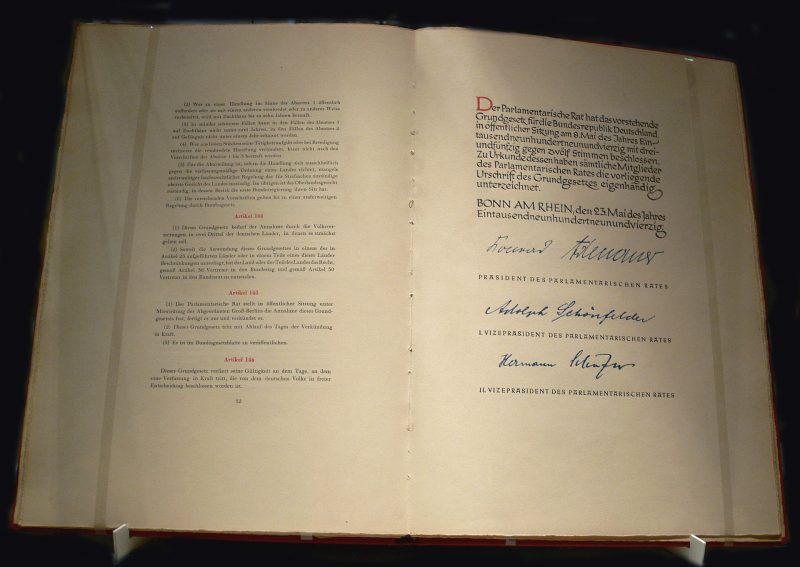
Playwright Tony Kushner wrote of “beautiful systems dying, old fixed orders spiraling apart” in the 1990s, referencing the changes palpable at the end of the decade or so of Reagan America. As the world power system of the Cold War gave way to what Francis Fukuyama – perhaps a bit too hastily – termed “the end of history,” many things were in flux.1 A generation later, we are again at such a point in time, especially regarding the recent election in the United States. It is an upset not merely of the American political landscape, but of the balances of alliance and trade that define the world in which all of us live. It is a troubled and troubling time. A time that looks for guidance.
The United States, more than most countries, perhaps more than any other country on earth, is based on an order that is itself based on the guidance of words. Its founding credo, ringing true to some and hollow to others throughout the ages, holds that “all men are created equal.” Every human being has the same rights. This is a North Star. Like the North Star, it sometimes shines brightly and is sometimes covered by dark, dreary clouds. But that it cannot always be seen does not mean that it is not always there.
Its message of equality, though trampled on by the very same people who wrote it, shone through nonetheless. It is what moved abolitionists to tackle slavery, despite the unlikeliness of success. Slavery was, after all, the very economic basis of half the nation. When women fought for the vote, they used the words of one of the nation’s founding documents to make their case for it. There was something potent in the Declaration of Independence’s repeated accusations against King George III: “He” had “refused,” “dissolved,” “forbidden,” “obstructed.” The Declaration of Sentiments which argued for female suffrage in 1848 took the words by their literal meaning. “He” now stood for men in general. The men who had “deprived her,” “taken from her,” “denied her,” stood accused of committing the gravest offense: to have been like a king. To have betrayed the spirit of America’s founding words. In the twentieth century, too, the Civil Rights Movement marched in Selma and marched on Washington and repeated these words, and held accountable those in power to hear these words and finally act accordingly.

The founding documents of the U.S. are positively what created the nation. Above mere geographical distance from England and above the creation of a culture of its own, the words contained in the Declaration of Independence, the Constitution, and its Bill of Rights, born out of a revolution, set America apart from Britain. Indeed in its creation of a wholly new system of government never before tried on such a large scale they set it apart from the world.2 It behooves anyone to know and read these documents, whether they are American or not. In important ways these texts are the beginning of a long winding road to the recognition of human rights as a universal good. In important ways these documents also, for the first time, gave central notions of Enlightenment philosophy the full force of law – albeit only for some.
Germany, in contrast, is a country defined by its past as a negative. No today peaceful and democratic nation got this way without condemnable acts committed on its territory, no country can claim to have always held the white banner of freedom and pretend the stains have never quite washed out. Germany outbid them all by descending into a cruelty so all-consuming that it has served as a byword for unspeakable terror ever since. Let’s not mince words: millions were killed as a result, in the Holocaust and in World War II. Religious and ethnic discrimination dropped swiftly onto a glide path into extermination. Here, too, words mattered. They were words of hatred that many too long denied were potent, words that many too long thought were just words and did not carry with them the power to become acts of evil. But that they did. Words have that power.
When Germany emerged from the rubble of a devastating war it had inflicted on the world and on itself, the framers of a consitution for one of the nations founded on its territory were influenced by the victorious Allied Forces, most of all the United States. They were influenced, too, by the ideas of the Declaration of Independence and the U.S. Constitution. The framers of the new Western German Basic Law – a name that was supposed to express the transitional nature of the constitution drafted, which was hoped later to apply to Eastern Germany as well – had the lessons from Nazism well in mind.
With the will to create a democracy that would not again fail and fall prey to extremism as had the Weimar Republic a decade and a half earlier, they began the document with nineteen articles given special status. These cannot be changed. As long as the Basic Law is valid, they are valid, too. They include a robust bill of rights and guarantees, contained in nineteen articles of Basic Rights. Most prominently, in article 1, paragraph 1: “Human dignity shall be inviolable. To respect and protect it shall be the duty of all state authority.” From this, meant originally as a preamble to specific, guaranteed rights, and since widely interpreted as being the “right to have rights,” every other civil right flows.

As state authority in combination with an ethnic nationalism had become discredited, Germans turned to that constitution to rally around. If there was patriotism to be had in the Post-War Era, it needed to be an altogether different kind of patriotism than the destructive, ethnic kind of the past. The philosopher Jürgen Habermas is most closely associated with the term for this kind of patriotism. “Verfassungspatriotismus,” or “constitutional patriotism”.
Habermas took the word and concept from its inventor, Dolf Sternberger, and elaborated on it, rooting it in his own idea of the public sphere.3 In essence, constitutional patriotism calls on people to identify not with the country they live in as a mass of land or the place in which a biologically identifiable “people” live. Instead, patriotism flows from the adherence to and identification with a constitution and, above all, its guiding democratic principles. It connects both to the past – to the writing of the constitutional documents – and to the future, in which their promises can be more completely fulfilled, or in which the principles and freedoms laid out in them will have to be defended.

To be clear, despite the lofty rhetoric that constitutions use and that satiates discourses of national pride and civil religion, I am not here advocating for an originalism of constitutional interpretation. Instead, I am arguing in favor of what Anna Stilz has called “not a constitution in the fixed sense, defined by appeals to Founding Fathers, a sacred document, or the ancestral heroes of the nation” but “an ongoing constitutional practice that is at the same time a collective practice of self-definition.”4
This brings me to the current day. You start with words, the words of a constitution. But it is not these words alone, the words of flawed people in flawed times, that will help you on your path. It is the practice of your constitution that will. Make this practice your shield, your bow and your arrows. It may not protect you in every moment, but it will let you fight.
When truth itself is under attack from the highest places, buried under a barrage of bullshit and hidden in the tall grass of fake news, as it is in so many places today, look again and again to your constitution. Look at the letter and sense the spirit of its laws. If ever you find anyone in power to infringe upon either, make yourself heard. Act, organize. Raise hell, over and over again. Do not stand down. Get loud and be uncomfortable. It’s what patriots do.
- As many “big ideas,” this one, too, is often simplified too much. Fukuyama in fact allowed for a possible end to the end of history, when the capitalist consensus could break down. Francis Fukuyama, “The End of History and the Last Man” (New York: Perennial, 2002). ↩
- Gordon Wood’s “The Radicalism of the American Revolution” (New York: Knopf, 1992) is a go-to book here. This is not to say that Wood’s interpretation doesn’t at times suffer from the fact that it is somewhat too celebratory and “Whiggish”. It is, however, a good starting point. ↩
- Forgive my oversimplification of a long, complicated discussion. Here is not the place for a full elaboration of the notion of constitutional patriotism, which has naturally seen its critics and varying interpretations. Perhaps the best English-language book for further reading is: Jan-Werner Müller, “Constitutional Patriotism” (Princeton: Princeton University Press, 2007). ↩
- Anna Stilz, “Liberal Loyalty. Freedom, Obligation, and the State” (Princeton: Princeton University Press, 2009), p. 168. ↩